
The Origins of Shaving: Prehistory
Throughout history, the barber has undergone many transformations. Not only have barbering techniques evolved, but so too have the styles of beards and hairstyles, their functions within society, and even the role of the barber himself.
To understand the origins of the profession, we must go back to the very beginning—long before civilization, long before metal, and long before the first known razors. Our story begins in prehistory, more than 10,000 years before Christ.
As Martelli noted in 2019, the barber has always occupied a prominent place throughout history. Yet evidence of shaving and hair grooming reaches much further back than many people realize.
Archaeologists have discovered rock carvings dating back more than 10,000 years before Christ, depicting men with both long and short beards standing side by side. Some of these images even appear to show individuals grooming and shaving one another. Although these practices were naturally far more primitive than those known today, they suggest that shaving already existed among prehistoric peoples.
During the Paleolithic period, or Old Stone Age, which extended from approximately 2.5 million years ago until around 10,000 BC, and later during the Neolithic period, or New Stone Age, between roughly 10,000 BC and 2,000 BC, numerous sharp tools and shells have been uncovered. These objects differ considerably from the weapons found in the same regions.
For this reason, archaeologists believe that many of these instruments were intended not for hunting or warfare, but for personal grooming and the maintenance of hair and beards. In particular, the sharp edges of shells, flints, and polished stones are thought to have served this purpose.
Additional evidence can be found in prehistoric rock carvings in which early humans are portrayed with little or no facial hair. These depictions further strengthen the theory that shaving was already a familiar practice within early human societies.
Most likely, the removal of facial hair was not performed solely for aesthetic reasons. Practical considerations such as hygiene, comfort, and perhaps even social status within a tribe or community may also have played an important role.
Although the techniques and materials available at the time were extremely rudimentary, these discoveries demonstrate that mankind has devoted attention to personal grooming for thousands of years. The desire to care for oneself and to distinguish oneself from others therefore appears to be almost as old as humanity itself.
Flint Stones and the Earliest Forms of Shaving
One of the most remarkable objects associated with prehistoric grooming is the flint stone, also known as silex. Possessing naturally sharp edges, these stones were capable of cutting and scraping.
Archaeologists believe that such sharp stones represent some of the earliest tools used to remove unwanted hair. Long before the invention of steel blades and straight razors, these simple instruments may have marked the very beginning of mankind’s relationship with shaving.
In many ways, these humble pieces of flint can be regarded as the ancestors of every razor that would follow.
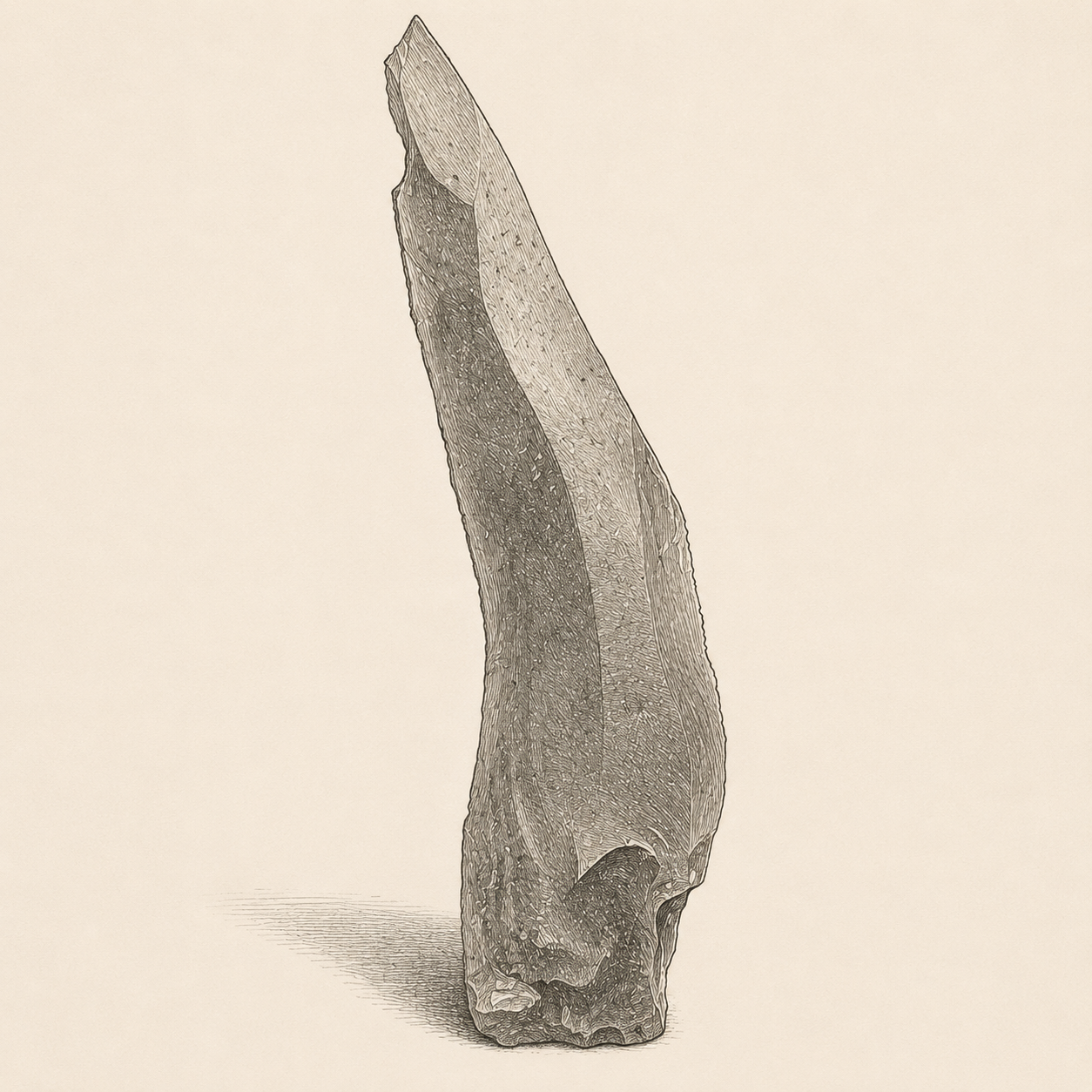
Figure: Flint or Silex stone possibly used during prehistoric times to remove excess hair.
Want to join the Scapicchio Academy at ROMAIN in Ghent, belgium?
Get in touch to plan your 1-on-1 training with Master barber Stijn De Sutter and take your straight razor, honing
READY FOR THE REAL THING?
If you want more than just a good story and you’re ready to sharpen your craft (or your own look), you know where to find us.
From straight razor training and honing on natural stone to classic shaves and serious beard work in the chair, ROMAIN Barbershop & Academy in Ghent is where it actually happens—no noise, no shortcuts.
Book a service in ROMAIN
https://booking.optios.net/6064/select-location
Follow the journey
ROMAIN on Instagram: https://www.instagram.com/romain_ghent
Stijn on Instagram: https://www.instagram.com/desutter_stijn
Stijn on YouTube: https://www.youtube.com/@desutter_stijn
Academy info, courses or questions
Email: info@romainghent.be and we’ll take it from there.
Website ROMAIN: http://www.romainghent.be
Website Scapicchio Academy: http://www.scapicchioacademy.com
